
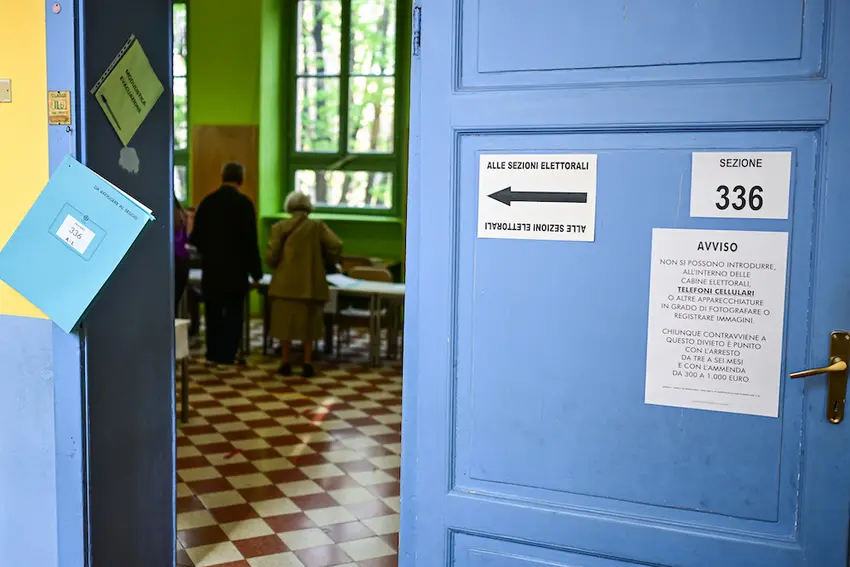
Residents of around 750 Italian towns will head to the polls on Sunday, May 24th and Monday, May 25th to elect their new mayors and city councillors.
Among the larger towns and cities electing their local representatives are Venice, Reggio Calabria, Arezzo, Mantua, Pistoia, Macerata, Salerno and Chieti.
Here’s what you need to know about how the system works in Italy.
Who can vote?
As well as Italians aged 18 and above, non-Italian EU citizens can vote in local elections in Italy (as well as European Parliamentary elections).
An EU citizen can even stand as a candidate in municipal elections, though they can’t stand for election as mayor or deputy mayor.
Non-EU foreigners resident in Italy can’t vote in these or any other type of Italian elections.
You’ll need to be registered as a resident with the town hall where you’re planning on voting and have your tessera elettorale (electoral card).
How do I vote?
For Italian citizens, it’s fairly straightforward: you just go to the polls in the town where you’re resident with a photo ID and your electoral card.
This is automatically issued to Italians when they turn 18, as well as to anyone who becomes a citizen after reaching the age of majority.
For EU citizens, there are some extra hurdles to jump: the first time you vote, you’ll need to apply to your town’s current mayor within 40 days of the elections.
You’ll need to give your nationality, address in both Italy and your country of origin, request to be registered with your town’s anagrafe population register if you aren’t already, and ask to be included on the electoral roll going forward.
READ ALSO: EXPLAINED: How to register as a resident in Italy
When can I vote?
The polls open from 7am until 11pm on Sunday, and from 7am to 3pm on Monday.
Run-off elections (see below) are due to be held on Sunday, June 7th and Monday, June 8th.
How does the system work?
Candidates are usually aligned with either left or right as part of a coalition, and are often running as candidates for Italy's biggest political parties.
These are currently the Brothers of Italy (Fratelli d'Italia), the League (Lega), the Democratic Party (Partito Democratico, or PD), the Five Star Movement (Movimento Cinque Stelle, or M5S), and Forza Italia.
The ballot allows you to vote for a mayoral candidate, a party list, or both, and you can even split your vote between a mayor and another party's list if you live somewhere that has at least 15,000 residents.
You can also express up to two preference votes for council candidates from your chosen list, but if voting for two candidates, they must be of different genders or the second vote will be cancelled.
Towns with populations of fewer than 15,000 hold just one vote, while larger towns hold a second round of run-off elections (known as “ballottaggio”) if the top candidate receives less than 50 percent plus one of the votes in the first round.
Comments